Understanding the Moroccan Dirham: Currency, ATMs and Safety
There’s a lot to get your head around when travelling solo to a new country and currency is one of them! What is it? How much is it worth in relation to your home currency? And what is the best way to get your hands on it?
As soon as you mention that the Moroccan dirham is a closed currency (it can’t be exchanged outside of the country), it adds another level of stress. In some ways, this means that you can’t prepare ahead of time. Well, not in terms of getting your hands (literally) on dirhams, at least.
But there are lots of ways you can prepare financially before a solo trip to Morocco, particularly when it comes to educating yourself about money matters.
Once you understand a few of its quirks, money in Morocco is relatively straightforward. For first-timers, most confusion comes not from cost and exchange rates, but from process: when to use cash, where cards work and why the Moroccan dirham behaves differently from many other currencies.
In this article, I’ll address all of the above to help you better understand the Moroccan dirham. Discover everything you need to know about the currency, how to use money in Morocco as a solo traveller and what to do when a financial disaster strikes.
Disclosure: This article contains affiliate links, meaning I earn a small commission when you make a purchase. Affiliate links cost you nothing and ensure my content stays free!
The Moroccan Dirham (MAD): What Makes It Different
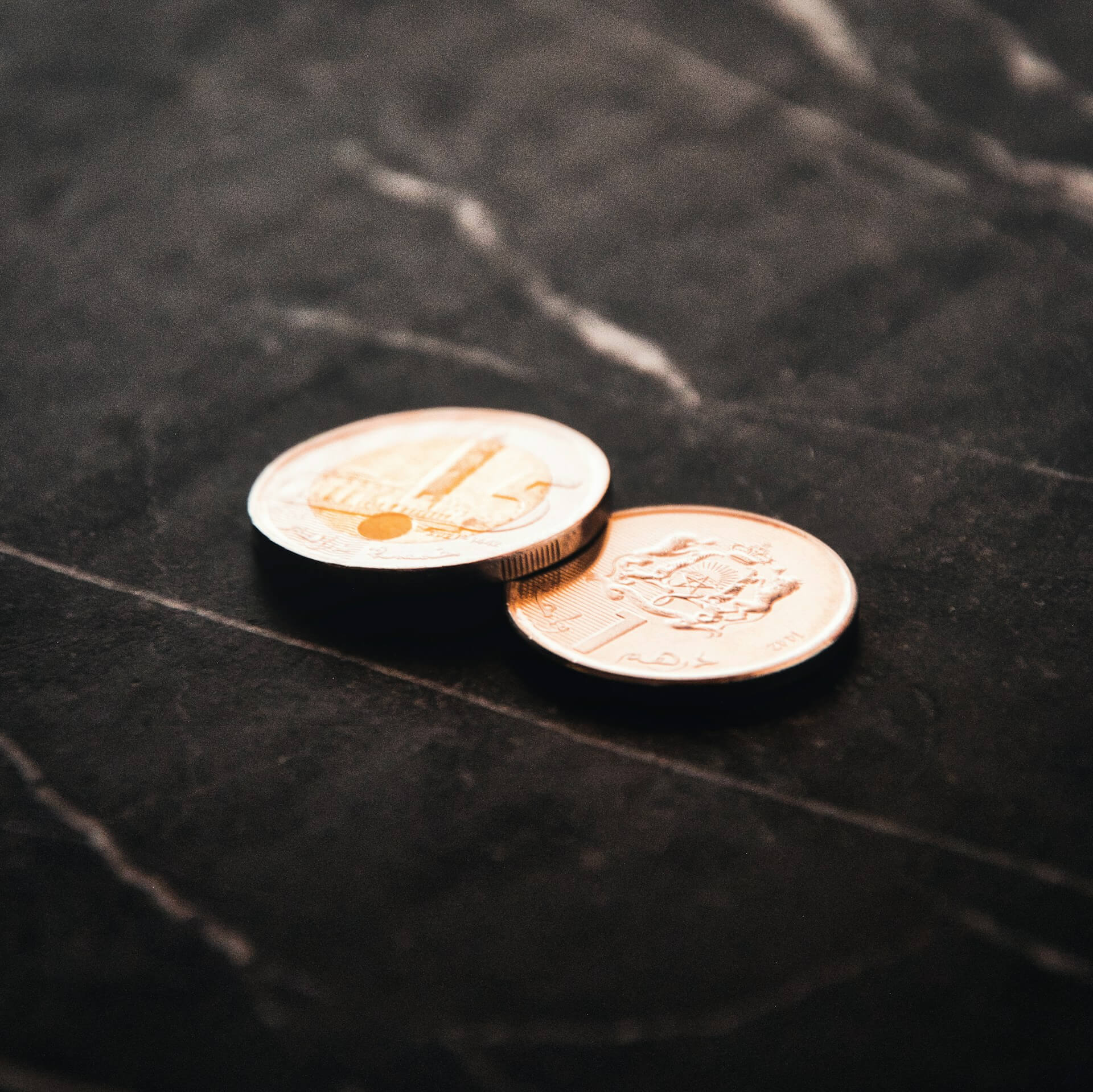
Morocco’s currency is the Moroccan dirham (MAD) and it’s a closed currency. That means you can’t legally take large amounts of dirhams in or out of the country.
In practice, this means:
- You can’t buy dirhams abroad before travelling to Morocco
- You need to exchange or withdraw money after arriving
- You should spend or reconvert any remaining cash before departure
Solo Tip:
Solo travellers need to be a little more prepared than those travelling with a companion. You don’t have anyone to fall back on if you can’t withdraw money from an ATM on arrival.
I would suggest arriving in Morocco with some USD or Euros in cash that you can exchange at the airport or a city office if your debit/credit card isn’t working. It may be that your card isn’t compatible with the ATM at the airport and you need to “shop around” for ATMS in the city.
If you have some cash, at least you can get a taxi or bus from the airport to your accommodation. Then, you can find a solution.
Moroccan Currency Basics:
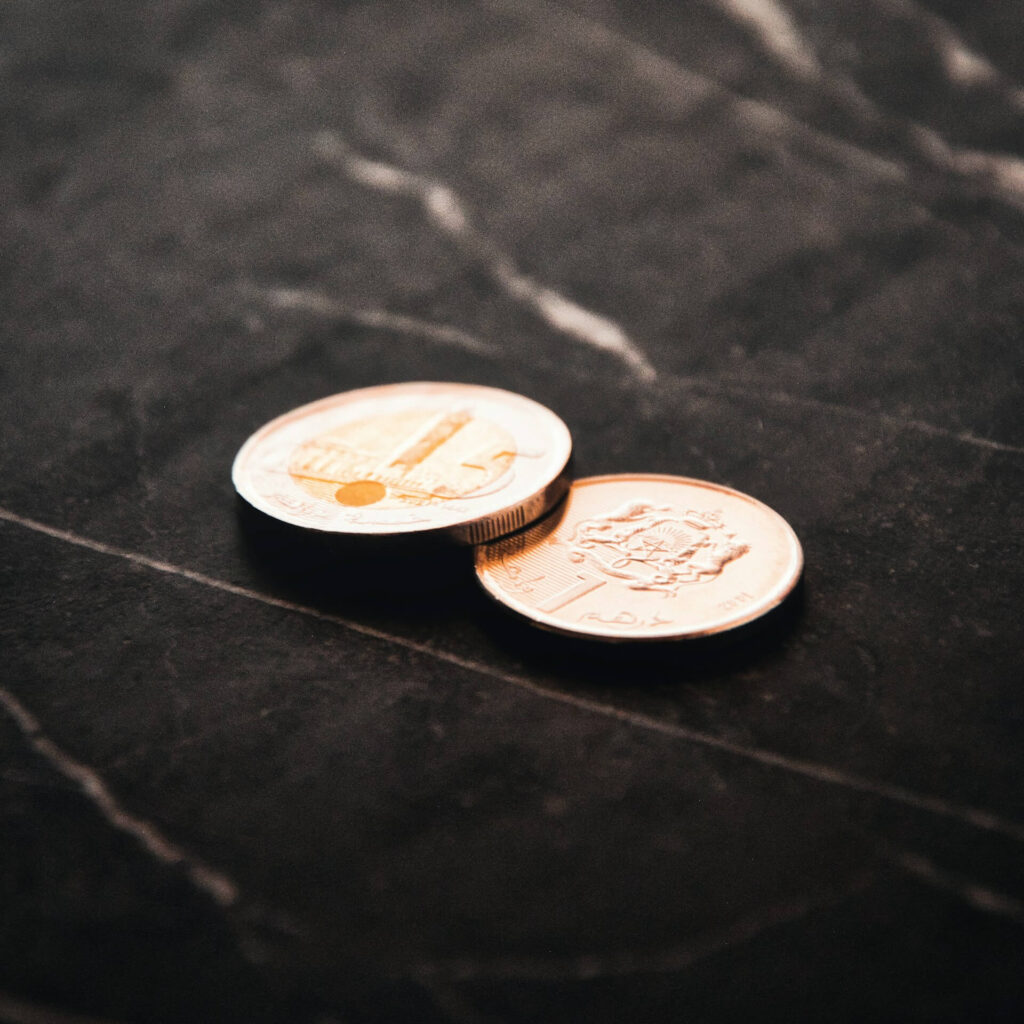
- Coins: 10, 20 and 50 centimes (small change)
- Banknotes: 20, 50, 100, and 200 dirhams
- Exchange rates fluctuate, but typically $1 USD = 10-11 MAD (as of 2026)
Cash Is King
Outside of higher-end hotels, riads and restaurants, cash is essential.
You’ll need dirhams for:
- Taxis and local transport
- Souks and small shops
- Cafes, local restaurants and street food
- Small guesthouses, budget riads and rural hotels
- Tips
Even places that technically accept cards often prefer cash and it’s not uncommon that card facilities are “temporarily out of service”. Card payments in Morocco almost always incur a surcharge, usually between 3% and 5% of the purchase price.
How much cash should you carry in Morocco? That really depends on the individual and what you’re comfortable with, as well as your plans that day.
I usually carry around 1000 MAD while I’m out sightseeing. It’s enough for museum entrance fees, a meal or two and small purchases. I’ll also have one debit card on me, so if I stumble across something more expensive I want to buy (that requires cash), I can find an ATM.
Using ATMs in Morocco
ATMs are widely available in towns and cities across Morocco, often outside banks and on the edge of public squares. They can also be found at airports, making it easy to withdraw cash as soon as you arrive to use for taxis, buses and airport shuttles.
Most ATMs accept international debit cards and withdrawals are usually capped per transaction. In my experience, most banks in Morocco cap their ATM transactions at somewhere between 2,000 and 3,000 MAD (roughly 200 to 300 USD or Euros).
Every ATM I have ever used in Morocco charges a fee, which is in addition to whatever fees your home bank charges for overseas ATM use. Fees differ widely, depending on the bank and ATM, so it’s worth “shopping around”.
I’ve noticed that the ATMs on the edge of Djemaa el-Fnaa in Marrakech charge a much higher transaction fee than elsewhere in the city. Probably because there are so many tourists looking for cash in that area!
The good news? ATMs always notify you of the fee before processing the transaction, so you can cancel it if you want to look elsewhere.
Occasionally, ATM machines in Morocco run out of cash, although this has never happened to me. I’ve only heard about it anecdotally. In most places, there will be more than one ATM, so there’s usually an alternative.
Solo Tip:
If you don’t want to carry around large amounts of cash, but don’t want to incur lots of ATM fees either, allow time to “shop around” for a low-fee ATM. Once you find one, it’s always going to be there and you can return whenever you need.
Smaller towns in Morocco may have limited or no ATMs, so I’d recommend withdrawing cash in the city before heading to remote destinations.
Also, try to withdraw cash during bank business hours wherever possible. That way, you can go into the branch immediately if your card is swallowed or you encounter any issues.
ATM Safety Tips in Morocco for Solo Travellers
- Use ATMs inside banks or well-lit, secure locations
- Shield your PIN when entering
- Keep your cards separate from your wallet
- Never accept help from strangers at ATMs
Card Considerations Before Leaving Home
Before travelling to Morocco, check your home bank’s fees for international transactions and consider opening another account if they are unreasonably high. Some banks also offer “travel cards” with lower ATM fees than their regular debit cards offer.
I’d also suggest travelling with more than one card (have at least one backup), just in case your card is lost, eaten by an ATM machine or compromised during a transaction.
Unfortunately, I had my debit card compromised last year while travelling in Laos. My bank immediately cancelled it when strange transactions started to appear.
Thankfully, I didn’t lose any money. But once the card was cancelled, I could no longer use it, and my bank wasn’t going to reactivate it under any circumstances.
Luckily, I had another debit card with me and could use that until a replacement was sent. But if I hadn’t had one, I don’t know what I would have done!
Exchanging Money in Morocco
I know that some travellers like to arrive in a new country with a strong foreign currency (USD, Euros, Pounds) and exchange it on arrival. This is easy to do in Morocco at airport exchange counters, city banks and licensed exchange offices.
Generally speaking, rates are better at city-based offices than at the airport. I’d recommend exchanging only a small amount at the airport and waiting for a better rate elsewhere for the bulk of your exchange.
Hotel exchange rates are usually poor. Look for a local (licensed) exchange office instead.
Never exchange with unlicensed money offices or on the street – ending up with counterfeit currency is just not worth the risk.
And remember to keep your exchange receipt if you plan to convert leftover dirhams back before leaving Morocco. Because the dirham is a closed currency, many banks and exchange offices like to see proof of the original exchange when you reconvert back.
It’s also worth noting that Morocco runs on small denominations, so request some 20 and 50 dirham notes amongst all the 100s and 200s. They make paying for taxis and small purchases easier – you’ll avoid those “no change” situations (which are really common in Morocco).
Tipping in Morocco
Tipping isn’t mandatory in Morocco, but it’s quite common and really appreciated by those working in the service industry. I would say that being respectful towards service workers is also highly valued. So if you can’t afford to tip, be sure to show your gratitude in other ways.
When it comes to tipping, I just round up taxi fares and add on roughly 10% to restaurant bills. I usually settle on a figure that doesn’t require a lot of change from whatever note I have available.
For larger tips (such as for tour guides and drivers), don’t hesitate to offer Euros or USD if you don’t have enough dirhams available. Just make sure it’s a currency they can easily exchange.
Personally, I like to keep some coins on hand to offer to people in need, as looking after the less fortunate is a big part of Moroccan culture. You will often see elderly people with their hand out in the street and they might be relying on the kindness of others for survival. Not everyone receives a pension.
My husband told me to say “bismillah” when handing over money in these situations. Then, place a hand on your heart as a sign of humility.
Card Payments in Morocco: Where They Work (and Don’t)
“Can you use credit cards in Morocco?” and “Is Morocco cash only?” are questions I get asked a lot.
While credit and debit cards are accepted at an increasing number of places in Morocco, the phrase “cash is king” still rings true here.
To give you an idea of what you might need where, let’s play: Morocco Cash or Card!
You can pay with credit and debit cards at most large hotels and riads, although occasionally (usually at smaller properties), they will require cash.
Most chain supermarkets will also accept cards, as will upscale and mid-range restaurants. Most budget restaurants are cash only.
Some tour operators will accept card payments – it usually depends on the size of the operation. Always ask first!
Cash is the main means of payment in souks and at local cafes, as well as when using petit and grand taxis.
You can purchase train and bus tickets using cards at station counters. But bring some cash if you want to buy food and drinks on board (train only). Payments for luggage (on buses) are made in cash.
The moral of the story? Always carry some dirhams, even in cities, as you will likely need cash at some point throughout the day.
Budget Planning for Solo Travellers in Morocco
Daily Budget Estimates:
- Budget traveler: $25-50 USD/day
- Mid-range: $50-100 USD/day
- Luxury: $100+ USD/day
Money Safety Tips for Solo Travel in Morocco
Morocco is generally safe, but as with any travel destination, taking basic precautions is important. After more than 10 years in Morocco (and having visited almost 100 different countries), here are some of my top money safety tips:
- Split cash between your wallet, bag and perhaps even a money belt
- Don’t flash large sums of cash in public
- Keep emergency funds separate, along with a backup debit/credit card
- Be cautious of pickpockets in crowded areas (particularly Djemaa el-Fnaa)
- Most hotels and riads have safes for valuables – use them!
- Keep transportation money accessible
- Take out travel insurance as financial protection
Emergency Financial Planning
Nobody wants to find themselves in stressful scenarios when it comes to dealing with money abroad. But the fact is, it happens! The best way to prevent a situation from bringing your trip to a grinding halt is to be prepared.
What to Do When Money Goes Missing
If money goes missing (accidentally or stolen), you lose your card or your card details are compromised, it’s not the end of the world.
- Contact your bank immediately to block cards if lost or if you notice suspicious activity
- Report to police if a card or money is stolen and get a report for insurance purposes
- Use emergency funds you’ve hidden separately until you can regain access to your bank account
- Contact your embassy if you find yourself in a financial situation that you can’t resolve independently
Backup Financial Resources
No matter where in the world you’re travelling, it’s important to have a backup means of accessing money, just in case your primary option is taken away from you.
- Emergency cash in multiple locations
- Backup credit/debit cards with different banks
- Digital wallet with some funds
- Friends/family who can wire money in emergencies (cash pickups are available from places like Western Union, MoneyGram, Wafacash and Poste Maroc)
Banking and Financial Preparation
Lots of travel planning revolves around deciding on an itinerary and what to pack. But being financially prepared is just as important.
Before You Leave Home
- Inform your bank about your travel dates and destinations (my banks allow me to do this through their app)
- Check international fees and order cards with the lowest fees
- Set up online banking to monitor transactions
- Download banking apps for managing accounts on-the-go
- Download a currency converter app so you can check exchange rates on-the-go
- Arrange backup payment methods (different cards, cash)
When You Arrive in Morocco
- Exchange money at authorised locations or withdraw cash at ATMs
- Check that your hotel/riad has a safe (and use it!)
- Split and hide your emergency cash supply
- Keep small bills handy for transportation and daily expenses
- Use credit/debit cards strategically to avoid reliance on cash
- Monitor bank transactions regularly to detect suspicious activity early
Before You Leave Morocco
Because the dirham is a closed currency:
- Spend any remaining cash before departure (it can’t be exchanged outside Morocco)
- Exchange it at the airport or bank (city-based offices usually have better rates)
- If you’re a collector, keep a few small bills and coins as a memento of your trip
The Bottom Line
At the end of the day, nobody wants to spend their precious holiday time worrying about money. Do I have enough cash? Should I pay for this purchase with a card? Am I getting the exchange rates right? It’s a lot!
By understanding the dirham system and money issues specific to Morocco, you’ll be able to navigate the country’s financial landscape with confidence.
Remember that cash is still king in many parts of Morocco, so always have enough local currency on hand (without feeling like you have an unsafe amount of cash). And always have cash/card backup plans up your sleeve, just to be on the safe side.
As a solo traveller, you have to be a little more on top of money matters than when you’re travelling with a companion. After all, there is no one to fall back on if your wallet is stolen or your card is eaten by an ATM machine.
But that doesn’t mean it has to be stressful either. It’s all about being informed and knowing exactly what to do if a mini financial disaster strikes. I hope these money tips for Morocco travel have done just that!
PLAN YOUR TRIP WITH MY FAVOURITE RESOURCES:
Find hotels via Booking
Book tours and attractions via Viator or GetYourGuide
Find a rental car via Discover Cars
Book flights via Kiwi or Booking
Search for buses and trains via 12Go or Omio
Get travel insurance via SafetyWing
Buy a digital eSIM with Airalo
By purchasing through my links, you’ll be supporting my website at no additional cost to you
-
Is December a Good Time to Visit Morocco? A Solo Traveller’s Guide
December in Morocco is a bit of a mixed bag. It can be crisp, sunny days beneath snow-dusted mountains. Or it can (as 2025 taught us during the AFCON tournament) be grey skies and heavy rainfall. If the last 10 years in Morocco has taught me anything, it’s that December is a month of contrasts:…
-
Is November a Good Time to Visit Morocco? A Solo Traveller’s Guide
If you’re considering a solo trip to Morocco in November, you’re looking at one of the country’s most underrated months. In my opinion at least! There’s usually a bit of a lull in tourist numbers following the idyllic weather of early autumn and before the influx of people who arrive at the end of December. …
-
Is October a Good Time to Visit Morocco? A Solo Traveller’s Guide
If you’re planning a solo trip to Morocco, October is considered by many people to be one of the best months to go. And I have to agree! The intense summer heat has eased and the Sahara once again becomes accessible. Oh, and the Atlantic waters are still warm enough to swim if you’re craving a…
-
Is September a Good Time to Visit Morocco? A Solo Traveller’s Guide
If you’re planning a solo trip to Morocco and debating when to go, September might be the sweet spot you didn’t know you were looking for. The extreme heart of summer is beginning to fade and peak-season crowds are starting to thin out. But the ocean’s still warm enough to swim and the desert’s becoming…
-
Is August a Good Time to Visit Morocco? A Solo Traveller’s Guide
If you’re considering a solo trip to Morocco in August, you’ve probably got one big question on your mind: Is it too hot? The honest answer: it depends on where you go and what kind of experience you’re looking for. Personally, August isn’t one of my favourite months to be in Morocco. But that’s because…
-
Solo Travel Morocco: Dealing with Harassment and Street Attention
One of the most searched questions about solo travel in Morocco (particularly from women) isn’t about riads, souk shopping or desert tours. It’s about harassment and catcalling in the street. I’ve experienced it personally and I know how upsetting it can be. It makes you feel unsafe (even when it’s not malicious) and it stops…

I’m Malika, an Australian-born travel writer with an intense love for Morocco. I first travelled here solo in 2014 and after meeting (and marrying) a local, I made this North African gem my home.
Over the last 10 years, I have explored the country extensively, travelling to all corners with my partner, friends and solo.